

What you need to know if a drone crashes into your home
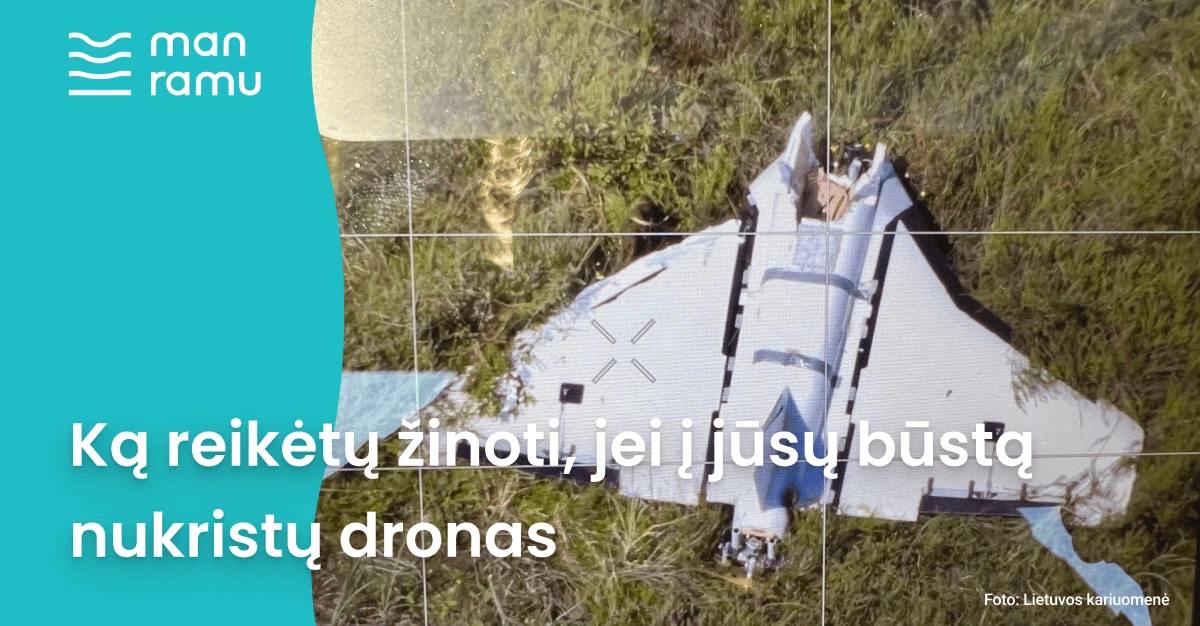
Recent geopolitical events and the development of unmanned aerial vehicle (drone) technology have brought new risks and questions. The press coverage of a drone of unknown origin and purpose (possibly a Gerbera) that flew over Vilnius and landed at the Gaižiūnai training ground, makes residents wonder: what would happen to their home insurance if such a drone landed on their house or flew through their apartment window? In this article, we look at what Lithuanian insurance companies provide and what you should pay attention to.
When is a drone crash considered an insured event?
All the main insurers in Lithuania – Lietuvos draudimas, ERGO, Balcia, BTA, Compensa and Gjensidige – include in their home insurance rules the risk of fire as ” the fall of a controlled flying machine, its parts or cargo”:
- The Rules of Lietuvos draudimas explain this risk as the impact or collision of a controlled (or uncontrolled due to a malfunction, accident or pilot’s faulty actions or inexperience) flying machine, its parts or the cargo carried by the machine with moving or stationary objects;
- Balcia’s wording: ‘Crash of an aircraft, its parts or its cargo’ means the direct fall of an aircraft, whether manned or unmanned, or its parts or its cargo;
- The ERGO rules state: ‘crash of controlled flying machines, their parts or cargo’;
- BTA defines it as “Falling of a manned flying machine, its parts or its cargo on the insured property”.
Thus, in all companies’ rules, this risk is considered as a standard insured event and does not require additional coverage.
This means that if a neighbour’s drone or model plane unexpectedly landed on your roof, window or balcony, your home insurance would cover the cost of repairs.
War and terrorism exceptions - where does the line of responsibility end?
All these insurance companies are unanimous in imposing limits on claims if the event is related to hostilities, invasion, civil war, mass disturbances or terrorist attacks. For example, Lietuvos draudimas states that no claim is payable if the damage is caused by war, putsch, riot or terrorist act. BTA notes in its rules that losses related to military operations, invasion, civil war or terrorism are not covered. ERGO’s exclusions reiterate that the insurance does not cover losses arising even indirectly from war or terrorist acts.
In practice, this means that if the drone is a military drone and the crash is considered to be the result of an act of war or terror, the insurance company has the right to refuse to pay the claim. This would be the case, for example, if a part of a Shahed unmanned aerial vehicle (UAV) used in warfare hit your house. And if the purpose of the machine is unclear (as in the case of Gerbera), the insurer will decide whether to treat it as a covered event on the basis of the official findings of the authorities.
What to do if a drone has landed on your home?
Above all, keep yourself and your loved ones safe. Whether the device is a toy drone or a suspicious flying object, the most important thing is to follow the rules for emergencies:
- Preserve life. If you are inside and you see a drone approaching or has already fallen through a window, do not open the windows or go to the crash site. If you are outside, move as far away as possible and warn others. If there are injured people, take care of them and follow first aid principles.
- Call 112. Notify the Emergency Centre immediately, giving a brief description of the situation and the exact location. Follow the dispatcher’s instructions to help coordinate rescue efforts and prevent more damage.
- Do not touch debris. A crashed drone can be dangerous: it may contain unexploded ordnance, flammable materials or electronics that can spark. Do not touch or carry debris or touch wires or other parts. Leave the area alone so that the authorities can inspect it.
- Only fix when it is safe to do so. Once the fire brigade or other services have confirmed that the area is safe, you can take photos or video footage that may be useful when dealing with the insurance company. The most important thing is that the recording only takes place when there is no danger to you or others.
- If you see a drone approaching and do not know its destination, stay in a safe place. Do not approach or attempt to catch the machine, as its trajectory cannot be accurately predicted. Indoors, it is safer to stay away from windows and outdoors, away from buildings, trees and power lines.
These actions will prevent further injuries and help the authorities to assess the situation more quickly. Only when you have avoided the danger and ensured your safety can you start recording the damage for insurance purposes.
Insurance rules may need to be adjusted?
Drone technology is evolving faster than insurance rules can adapt. While a few years ago, most policies only covered “aircraft crash”, meaning a directly piloted aircraft, there are now more and more drones and flying machines. Given that drones of uncertain purpose can reach our territory even in non-military conditions (e.g. a drone launched from another country goes off course), it is likely that in the future insurers will need to regulate in more detail when a drone crash is considered a military incident and when it is considered an insured accident.
Please note that it is not unnecessary to classify a crash of an aircraft or its parts as a fire risk. This risk covers events that are rare (fire, explosion), but usually have severe consequences and very high damage. Therefore, although the risk of being hit by an aircraft remains very low, home insurance is there to make sure that if something happens, you get real help.

“Golden hour” for photographers can be “black” for drivers
In autumn and spring, the low sun in the morning and evening becomes a real test for drivers. Find out what insurer statistics show and

When do you renew your compulsory car insurance?
40% of drivers hesitate about when to renew their insurance. Find out why it’s not worth delaying and how to avoid risk and financial losses.

Holiday Dangers for Pets: What You Need to Know About Decorations and Insurance
Christmas decorations and plants can be dangerous for dogs and cats. Learn how to protect your pets from accidents and when pet or home insurance
First snow on the roads: how to prepare and drive safely at the beginning of winter
First snow on the roads: learn how to drive safely in winter, prepare your car, defrost windows, and what essential items to have in winter.